Why the theme Time travel makes a good book
An adventure that suits the child
Time travel raises the big questions in a playful way. What did this place look like long ago? What will people eat in a hundred years? Were there children in Viking times, and what games did they play? A book about time travel lets your child visit other eras and see them with their own eyes, and still be home before tea gets cold. It sparks curiosity about both history and the future, and it shows that there have always been children, and they have always played, cried and laughed, whatever year it was.
Stops along the way through time
A time-travel book can stop in several places. Your child can help a Stone Age family light a fire, sail on a Viking ship, wander round a market in a medieval town, sit in an old-fashioned classroom writing on a slate, and then step straight into a future full of flying buses. Perhaps one object has to be brought back, or left in the right place, for everything to return to normal. If your child would like to stay longer in one era, there's the theme The Vikings, for example.
Your family's own timeline
A lovely way to make the book personal is to let the journey travel through your family's history. Where did Grandad live when he was little? What year was Mum born, and what was the world like then? Old photographs, a treasured heirloom on the bookshelf or a town where the family once lived can all become stops. A brother or sister can come along as a travelling companion, and the inventor of the machine can be Grandma.
A small child can follow a simple journey with clear pictures: then, now, later. At pre-school age, two or three stops are enough, with a friendly character at each one and a clear way home. Six-year-olds and up enjoy it when the journey has consequences, like an object brought back that changes something at home, and ten-year-olds love playing with the idea of meeting yourself.
A light from long ago
Every time we look at the stars, we're doing a kind of time travel. The light from a star has been travelling through space for so long that we see the star as it was when the light left it, often a very long time ago. Even from the nearest star after the Sun, the light takes more than four years to reach us. Go outside on a clear evening and look up together. Then talk about which time your child would most like to visit, and why.
Your child is the hero
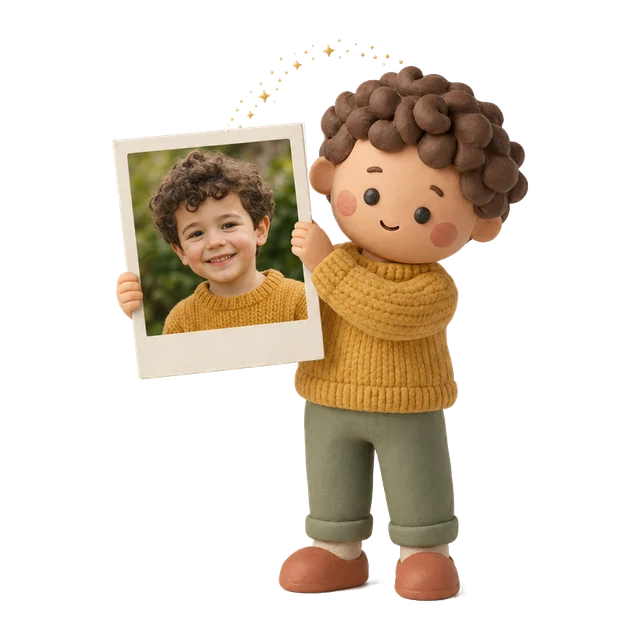
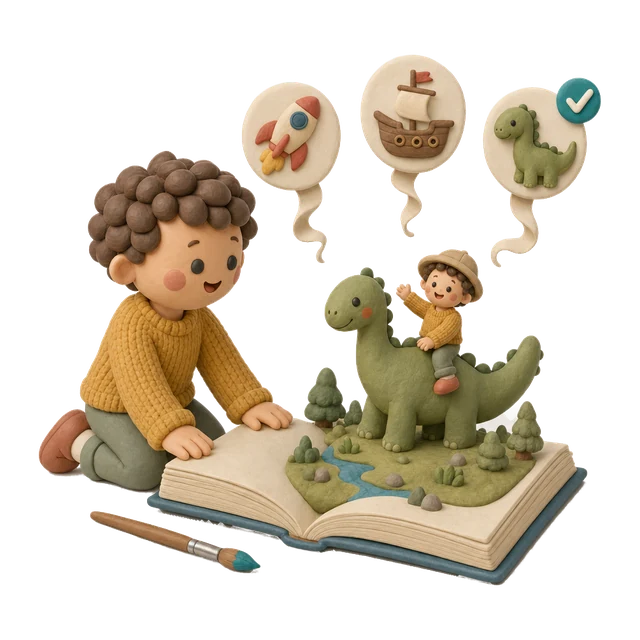
You fill in the child's name, age and what they like, and upload a photo. The story about time travel is written for your very own child, and the thirteen pictures and the cover are drawn from the photo in the style you choose. Brothers and sisters, parents, grandparents or the pet can come along, up to five characters. If you would like to include something that has happened lately, a trip or a lost tooth, just write it and it is woven in.
From eBook to hardback book
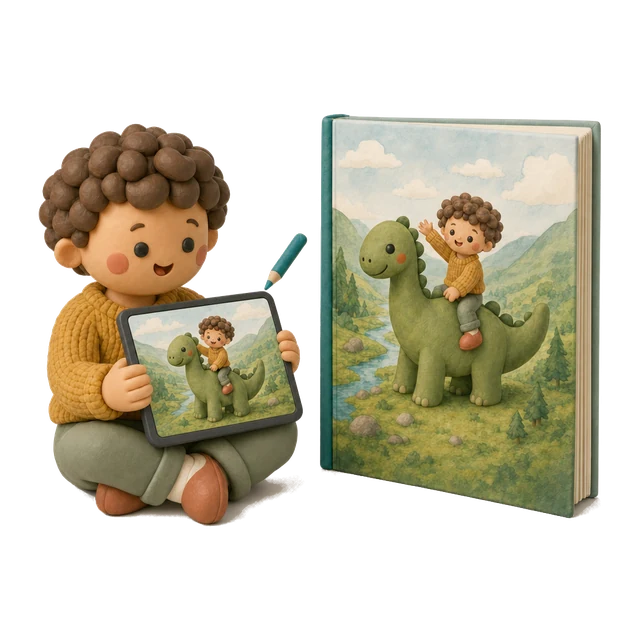
The eBook is ready a few minutes after payment. Read it, change the text and ask for new pictures until you are happy. Then order it as an A4 hardback book, printed and sent to your door, or straight to the child as a gift. Do add the colouring pages. Start creating the book or read more about the prices. Would you like to see a finished book before you decide? Browse our example books.
How the story could begin
Under a tarpaulin at the very back of Grandma's shed, there it is: an old washing machine, or something that looks like one. It has a dial on the front, but instead of temperatures and programmes, there are years printed all the way round. The arrow points to this year. You turn it back one notch, then another, and another. Something clicks inside. The door is big enough to crawl through, so you do. It smells like the air after a thunderstorm. A light blinks green, then yellow, then red, and everything starts to shake. When it's finally quiet, you open the door and peer out. The shed has gone. In front of you a horse is chewing on a blade of grass. Behind it there's a muddy track, smoke from a fire and a child in grey woollen clothes who points at you and shouts something in a language you can almost understand.
 Christmas
 Birthday
 Unicorns
 Dinosaurs
 Pirates
 Space
 Princes and princesses
 Fire brigade
 Sport
 Mermaids
 Superheroes
 Knights and dragons
 Construction vehicles
 Starting school
 A trip to the farm
 Jungle
 Fairies
 Treasure hunt
 Underwater
 A new baby
 Brushing teeth
 Confidence
 Bedtime story
 The enchanted forest
 Witches and spells
 Giants
 Gnomes
 Wizard school
 Camping
 Time travel
 Haunted house
 Police
 Racing
 Aeroplanes
 Secret mission
 The zoo
 Dressing up
 Building a tree house
 The amusement park
 A train journey
 A visit to the doctor
 The dentist
 The library
 The beach
 The forest
 Baking
 Music
 Dance
 Ancient Egypt
 The Stone Age
 The Vikings
 In the future
 The Middle Ages
 Candy land
 At the North Pole
 The savannah
 Easter
 Halloween
 Lucia
 Midsummer
 New Year
 Name day
 Eid
 Hanukkah
 Becoming a big brother or sister
 Father's Day
 Mother's Day
 Grandparents
 A new pet
 Moving house
 Sleepovers
 A wedding
 Holiday
 Learning to ride a bike
 Giving up the dummy
 Potty training
 Tidying up
 Eating well
 Learning to tell the time
 Learning to count
 The alphabet
 Seasons and weather
 Afraid of the dark
 Tantrums
 Feeling homesick
 Being teased
 Jealousy
 Feeling proud
 Handling big feelings
 Funny story
 Olivia
 Muhammad