Why the theme In the future makes a good book
An adventure that suits the child
The future is the only place nobody has ever been, so you're free to dream about it however you like. How will people live in a hundred years? What will the robots do, and who will cook dinner? Children often have firm answers of their own, and a book about the future takes your child to a world where those answers have come true. It can be funny, a little strange and sometimes thought-provoking. Your child can ride a train through a glass tube, have a robot for a friend or be the one who invents something that solves a big problem.
What 2150 might look like
A story set in the future can take your child to a school on a space station, a city that grows all its food on its rooftops, or a home where robots help out but sometimes get everything muddled. Perhaps your child has invented a machine that makes rain clouds out of old plastic rubbish, or someone has to restart the city's great computer before dinner. The future is allowed to be bright, funny and a little bit bonkers. It could also be a trip to a future forest where the animals have come back, or a day when your child gets to drive the city's giant space lift.
Your child's own inventions
Ask your child what they would like to invent and write in the answer: a machine that tidies the bedroom, shoes that bounce, a robot that reads bedtime stories. Perhaps your child wants to be something in particular when they grow up – a pilot, a vet, a builder – and then the book can show that day. Parents, siblings and pets can appear in their future versions, with slightly greyer hair or a robot tail. Perhaps your child is the inventor, and the family are the first to try it out.
For small children it's lights, sounds and things that move: beep, whirr, a train that flies. Three- to five-year-olds love an ordinary day in the future with unexpected details. School-age children can be given a problem that takes ingenuity, and the oldest can handle a story that asks what we want to keep from today when everything else changes.
Draw a room in the future
After reading, each of you can draw an ordinary room in the future – the kitchen, the bathroom, your child's own bedroom. What's the same as today? What has disappeared? It's often surprising what children think will still be around. Anyone who would rather travel the other way, back in time, can look at the theme time travel. Talk, too, about what your child hopes will get better in the future – and what they could already do now, such as mending a toy instead of throwing it away.
Your child is the hero
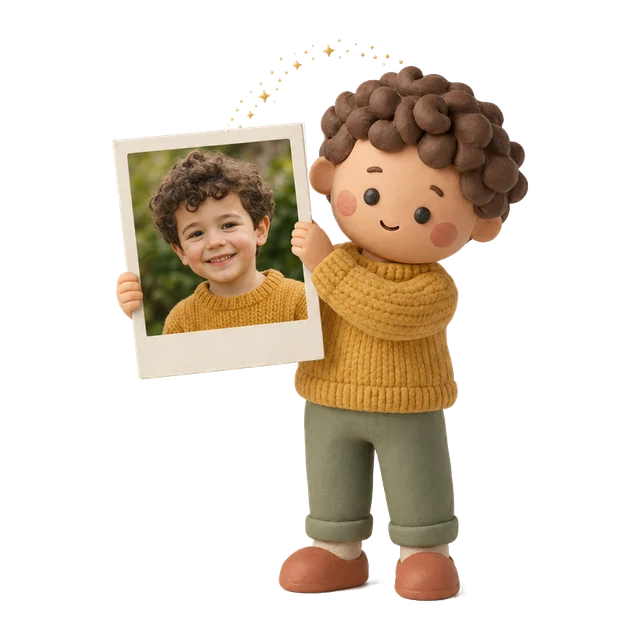
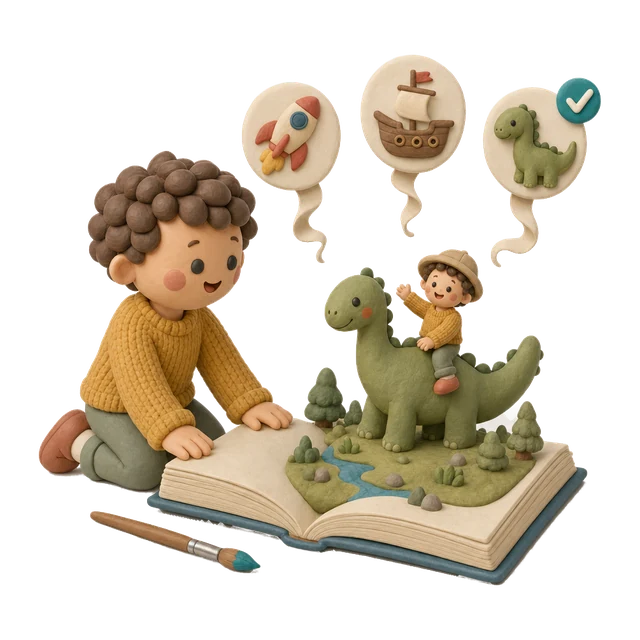
You fill in the child's name, age and what they like, and upload a photo. The story about the future is written for your very own child, and the thirteen pictures and the cover are drawn from the photo in the style you choose. Brothers and sisters, parents, grandparents or the pet can come along, up to five characters. If you would like to include something that has happened lately, a trip or a lost tooth, just write it and it is woven in.
From eBook to hardback book
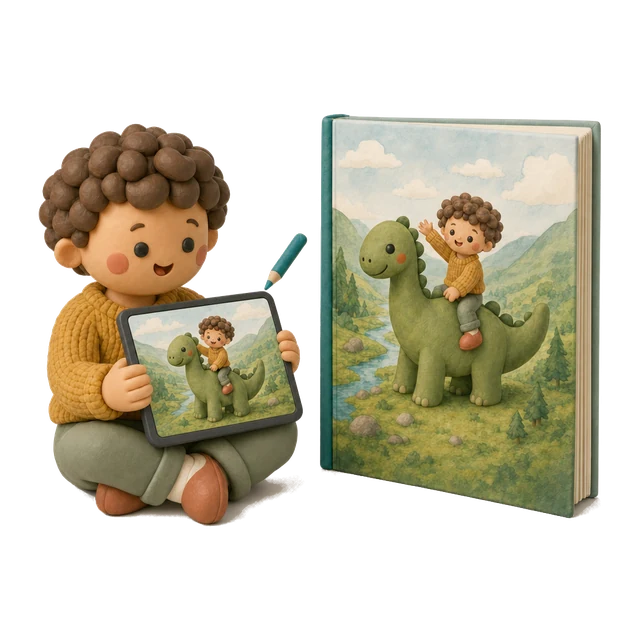
The eBook is ready a few minutes after payment. Read it, change the text and ask for new pictures until you are happy. Then order it as an A4 hardback book, printed and sent to your door, or straight to the child as a gift. Do add the colouring pages. Start creating the book or read more about the prices. Would you like to see a finished book before you decide? Browse our example books.
How the story could begin
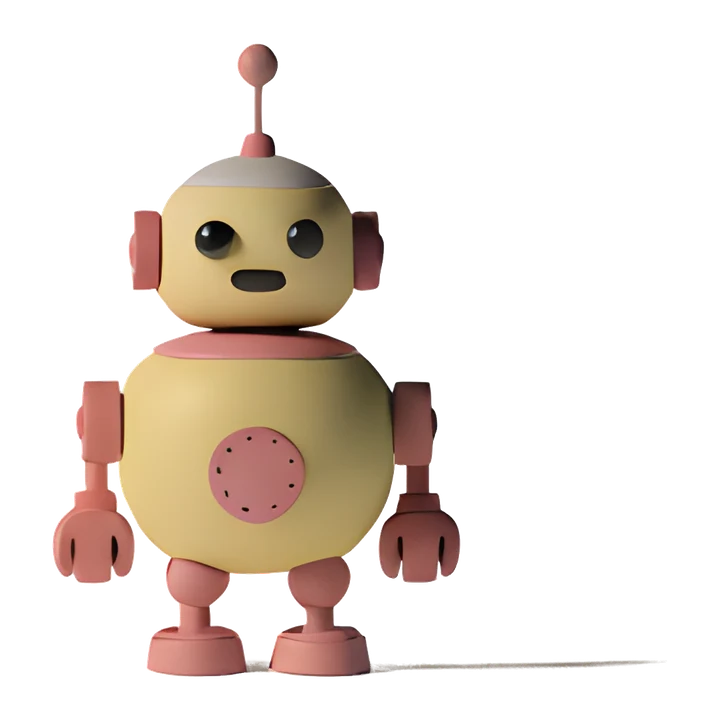
Your alarm clock is a little robot called Bix, and he wakes you by pressing his cold metal nose against your cheek. “Good morning,” he says. “It's Tuesday, in the year 2150, and breakfast is ready.” You pull on your jumper, and it changes colour to blue, because you feel like blue today. In the kitchen a plate of pancakes floats above the table. Through the window you can see the city: buildings that grow like trees, green roofs, little craft buzzing between the floors. But something is odd. All the craft are hanging still in the air, as if someone has pressed pause. Bix blinks red. “The city's computer has forgotten how to restart,” he says. “And the only one who has the key is you.”
 Christmas
 Birthday
 Unicorns
 Dinosaurs
 Pirates
 Space
 Princes and princesses
 Fire brigade
 Sport
 Mermaids
 Superheroes
 Knights and dragons
 Construction vehicles
 Starting school
 A trip to the farm
 Jungle
 Fairies
 Treasure hunt
 Underwater
 A new baby
 Brushing teeth
 Confidence
 Bedtime story
 The enchanted forest
 Witches and spells
 Giants
 Gnomes
 Wizard school
 Camping
 Time travel
 Haunted house
 Police
 Racing
 Aeroplanes
 Secret mission
 The zoo
 Dressing up
 Building a tree house
 The amusement park
 A train journey
 A visit to the doctor
 The dentist
 The library
 The beach
 The forest
 Baking
 Music
 Dance
 Ancient Egypt
 The Stone Age
 The Vikings
 In the future
 The Middle Ages
 Candy land
 At the North Pole
 The savannah
 Easter
 Halloween
 Lucia
 Midsummer
 New Year
 Name day
 Eid
 Hanukkah
 Becoming a big brother or sister
 Father's Day
 Mother's Day
 Grandparents
 A new pet
 Moving house
 Sleepovers
 A wedding
 Holiday
 Learning to ride a bike
 Giving up the dummy
 Potty training
 Tidying up
 Eating well
 Learning to tell the time
 Learning to count
 The alphabet
 Seasons and weather
 Afraid of the dark
 Tantrums
 Feeling homesick
 Being teased
 Jealousy
 Feeling proud
 Handling big feelings
 Funny story
 Olivia
 Muhammad